Showing posts with label abstract art. Show all posts

Wednesday, September 13, 2017

How do you deal with anger?

I'm angry. There needs to be contrast and darkness. Something inside me craves the play of opposites. I want to destroy my stupid mistakes, and enforce the vibrating texture of the main character and the background. Who cares what remains in focus: what's in the front and what recedes to the shadows? That is absolutely secondary.

I can't stand rejection. We all know we should not take it personally but every single time it's a knife that pierces straight to my heart and soul. I start hating everything I do.  I minimize all my accomplishments. This gnawing feeling that I'm worthless and utterly ungifted makes me want to slash it all, cut it up, and trash all these degenerate half-baked creations.Where is the darkness? I want it to be visible, to conquer the light, to penetrate my hopes and dreams. I need it to co-exist with the light and enclose it, and shape it.

Then, suddenly, this hatred passes and now there's too much contrast. My little inner child awakens and tells me that it's time to move on. It's time to balance it out and add some dimension. I'm that person that plows through. I don't dwell on the negative. I push myself to find new solutions. In these dark moments lies my strength. I find them disturbingly invigorating. They push me to new boundaries.

These nuances in mood and color bring depth and uncover the many dimensions of my life. I could be reveling in these contrasting color combinations forever. I love that it takes me four or five sessions to bring my paintings to completion. There is a span of all kinds of emotions, priorities, struggles captured with each piece. These feelings might not translate to the viewer, but they're apparent to me because I lived them all. These are little pieces of me, my true inner life away from the hustle and bustle of daily pressures.

Each canvas is a battered creation, attacked from all kinds of angles, yet made stronger because of its multiple mini-victories. I wonder what would happen if I could devote my sole attention to painting. Would these get somewhere faster, like they did while I was in college? Could my quest be solidified if I had all the time in the world - no work, no kids, no monetary concerns? Or are these paintings so incredibly deep because they reflect all of me: all my perturbations and the hundreds of existential questions I ask myself while I paint. One never knows. A fairy does not flicker her magic wand granting me a new life - so I make due with what's given me - n'est-ce pas?

For the painting that this process has produced, and more insights into life's existential questions sign on to my newsletter at www.dianastelin.com

Friday, December 16, 2016

My Favorite Artists on Instagram

As I explore Instagram as an outlet for my art, and as part of #taaigchallenge, I'm seeing some really great work, and I feel it's important to share it as means of inspiration.
I thought once in a while everyone needs some inspiration, so here are some of my favorites:

I love patches of harmonious color like #UweKowski
I love scraped off surfaces a la #Gerhard Richter
I love ghost trees in the style of #WolfKahn
I'd love my line to be as piercing as Hiroshige Fukuhara
I think the saturated scenes of Stevnn Hall are amazing
The color harmonies are simply perfect in Julia Powell's work:
and I'd love my symbols to be as spiritual as #Wassily Kandinsky, whose birthday is today incidentally...

But god damn it, I want it to be my language that combines all those and transforms into something new, blended seamlessly, yet making a contrasting statement. It'll stem from nature but be taken to an imaginary paradise: where borders are barely visible, where sky falls onto earth, and sand can rise to meet crashing waves. It's where trees can spread their curious branches far into the amplified skies, and they can separate the landscape into mini-icons where one's eyes rest while taking a break from the whole spectacle. It's now my color theory and not Quiller's or Kandinsky's. It'll be my melted, scratched, layered world where I can fit in all my hopes and aspirations, my struggles and disappointments.


Monday, September 26, 2016

Do all your problems need constant attention?

Foreground and background - what is important first and what needs to recede back - that was the overlaying message of this piece. I want this shift between voids and built up areas. At the same time, however, I want things to melt into one another. Yet, I keep on insisting that something sticks out.

Problems can't all be important at the same time. We're all constantly shifting our priorities but every time it's a struggle as everything seems equally important. Yet, if you treat all elements the same, then they're all flat - there's a lack of focus. It doesn't take a lot - numb one area with a duller hue and that instantly highlights another. Darken the background to contrast it with the foreground. Scrape away unwanted brightness and everything will become more subdued. Create and outline and things will adjust to their new forms and shapes.

And then it doesn't all have to be solved. Some areas can be left alone, remain as they are - not all issues are worth fighting for. Not all problems need our constant attention. There's a point when you simply learn to let it go. Perhaps a solution comes to you in another painting or life situation. Perhaps, it's simply not an issue after all.

Tuesday, March 15, 2016

Let your inner child play as long as she wants

Reflecting on a memory of a real landscape brings so many questions. Even after I figured out the mood for the painting, and limited my palette accordingly, I was still struggling with just how precise this depiction needs to be. As much as I wanted to leave the reality of the scene, things like perspective, shapes and textures of specific subjects were forcing me to stop and reconsider my every move.

When does this adherence to reality take a break, and lets the imagination take over? How can I open a door to creativity if a constant logical critic sits on my shoulder and demands accuracy and academic realism? How did Kandinsky accomplish this feat? To have a landscape and to not have it at the same time? To let shapes, colors and lines take over the composition? To have a real scene turn mythical, become a dreamscape?

I guess a lot of it is a dance of inner voices, but in a dance there's always a leading partner. How can the lead shift to a more abstract thinking section of the brain? Perhaps these voices relinquish control and don't take turns? When there's a real marriage of color and line - the trick is to not turn on the switch back to observation, and to just let yourself sink into the simple pleasures of mixing colors, the way a little child would, for hours.Yes, that is it. Just like I force myself (not always successfully) to not interfere and let my children play their game of choice for as long as they need, I need to not rush my inner child, and let her play as long as she wants. Then just stop before judgment kicks back in.

Then the goal is to repeat this for every painting session...and for every child's invented game.

Thursday, November 19, 2015

Everything needs its individual attention

The question of giving every student different treatment and a varied set of tasks based on his/her personality has been haunting me for a while. Time and time again I see that inevitably one or two students in each class need a lot more time on each project than others. I feel awful hurrying them along, as typically these are the students who truly pay attention to details, are quite the perfectionists and want every one of their pieces to truly become a work of art. But then what do I do with the rest of the group? I can't constantly split up, on occasion into three separate corners - where each student is doing something different based on his/her skill set and interests. It makes me crazy, I'm feeling like my head is about to explode in all these different directions.

This painting has been attempting to give me answers to that question. I went into it with my typical expressive approach, covering the canvas at once with slashes of my favorite palette knife. It all somewhat worked, but all the elements seemed to lack their own personality. And it occurred to me that I can't treat the surface of the water in a completely identical way in which I'm handling the tree growth, or the clouds floating along. They each move in their separate way: trees reaching up, clouds circling along, water drifting in horizontal lines. I need to copy their movement with my lines, being mindful of each and every personality, so that it could be a valid form in the composition, so that all these actors can have a dialogue with each other.

And yet, these are all parts of one whole painting, and all these personalities have to coexist in it. Trees and sky reflect in the water, merging and balancing out colors, shapes and lines of the final piece. It's just like all people ultimately coexist in one society, somehow learning along the way their ways to cope with that society's demands. So then even though a conversation with each student can be slightly different - should my final goal be to teach them integration into their group? That would ultimately give them an important life lesson, correct?

Tuesday, June 9, 2015

Traps

This painting has been a torture. It was attempting to come to life amidst declines from juried shows and galleries. I was in a particularly foul mood for weeks. Yet, it has been moving along despite it all and in a very strange way. I've been noticing that the drips don't just come down, (laws of physics and all), - they follow certain ridges and roads that I had left previously. Every time I would come back to paint, I'd be afraid that things would progress too fast. Yet, my barriers created intriguing little turns and twists for paint to follow.

At first, those closed gates seemed to play along with my depressive tune - 'you can't jump over your head', 'you can't go beyond your pre-set limitations' - little mean voice inside my head kept saying...

And then I returned one last time and suddenly thought - 'But wait, I am the one who creates these closed gates. It's completely up to me to open some and close others. It's my choice to direct the flow slightly. I set my own traps.

Just like in life, I can always walk into those pre-designed lived-in scenarios. Or, I can make a conscious decision to behave differently - not sacrifice myself, my time, my energy, but create more meaningful satisfying relationships.

It was truly brought home when I would stand as usual with one arm melting the paint, and the other holding a palette knife, ready to place another automatic mark in another section of the painting. But something inside of me kept saying time and again - 'no, put down the knife, use this arm to consciously turn the canvas and create new paths'...and I did.

Sunday, April 5, 2015

Controlled Impulses

I'm very impulsive by nature. Something comes over me and I follow the urge, I trust it to lead me to a good place. Most often than not it does. Yet, sometimes, I lose momentum, things start falling apart, and I blame it on the initial impulsive decision. Should I? Or is it that loss of faith in my intuition that dooms the task at hand?

I've just read a great NY Times article about restoration being done on Jackson Pollock's 'Alchemy', one of my favorite paintings of all times. Everyone always talks about automatic techniques Pollock had used, the pure happy accidents that followed, his constant drunken state. I never thought his pieces to be accidental, and I'm happy the article shows scientific support of this belief. Every drip area, every color combination was premeditated, even in very large works. Surely, his intuitive senses played a huge part, but so did his formal education, his analysis of how an onlooker's eye should move in a piece to make it lively and compositionally sound.

I just finished a piece that I was told differs greatly from all my other work: it feels larger, it's light is coming from within, it breathes. I'm thrilled with it, and I believe it's my trust and follow through on intuition that brought it to this state. Sure, I used my traditional melted drips, but they were carefully controlled, adjusted in certain areas, intensified in others. Layers kept piling on, yet each uncovered nuances underneath. The palette was limited: colors with which I had never experimented before were carefully juxtaposed. Finally, I left a lot of empty room for it to breathe. It's simply marvelous: it feels like a breath of crisp air. Intuition is certainly a force to reckon with yet nurture...

Wednesday, May 7, 2014

The need to RTFM

My husband is an engineer and his favorite saying when something isn't going right is: RTFM (read the .... manual).

I'm often asked to teach according to a step by step, or follow along manual, and I always refuse. It just seems to me that instructions of that sort kill any individual creativity, or ability to think outside the box and come to an unexpected, yet original solution. My motto has been to demonstrate the use of materials, give some background art history on the project, and see where imagination can take one as an artist.

Yet, with this latest painting I feel like I did what I preach against, and I can't say I'm happy with the outcome. I took an old watercolor from 1999 as inspiration, from the time when I loved the combination of nature and architecture. I thought that even if a rigid structure is there, I can let myself get to a point where I use it sufficiently, and then be able to let it go by melting it away.

But apparently this need for a manual has a strong hold even on me, not just on the engineer types. Every time I tried to lose a column or a window, or have the trees or grass spill over onto the existing planes- something within me rebelled. No matter how hard I tried, I proceeded as I'd been taught with as correct a perspective as possible, the shapes of the original building in the watercolor, and the forms of the initial trees.

So the question I guess is perhaps we as humans are programmed to follow instructions and I'm wrong to confuse myself and others with too much freedom? Perhaps creativity can succeed even within the confines of a manual?


Thursday, January 23, 2014

The relationships between

The more I delve into abstraction, the more I realize that objects themselves matter so much less than their relationships with other elements adjacent to them. What's truly beautiful is an object that is able to extend beyond itself, to influence others with its luminosity, to reflect and uncover their hidden beauty.

When you are around someone for a long time and you truly make an effort to relish the relationship - you melt into that someone. Yes, you compromise something of yours, but that makes you that much richer.

And then, just like you never know how exactly paint will behave in a given moment, you don't ever know when a relationship will take another turn. You might attempt to comprehend someone for years, and after all this trial and error realize you don't complement each other. With people this shifting of gears only causes tremendous stress and fear, and most times a certain end, good in the grand scheme of a life that constantly moves...but terrible in the day to day emotional well-being. It'd be so wonderful to approach these turns philosophically, even enjoy them like I do with paint's uncertainty, its wonderful element of surprise. You never know what new wonderful encounters will materialize tomorrow.

Wednesday, September 25, 2013

Melting away...all masks

As much as I try, I can't get away from reality. I can't reach within and call forth images sitting deep in some innermost layer.

So my new answer to all this representation is melt the reality...melt it away like the Wicked Witch of the West, remove all those built up textures, all these layers of masks.

The process is really difficult on me as it requires so much patience. It's the antidote to my fierce piercings with a palette knife.

What it does is slowly bring out all these unexpected nuances in color relationships, plays of textures that are so different from what I typically employ. Drips fall like tiny tears, so difficult to extract, always from unpredictable little caves, opening newer hideaway places, shifting priorities. It's like reliving a dream, peeling its meaning bit by bit, the unwilling truths. Bubbles of bile all of a sudden explode into fireworks of new answers. If all masks could shed like this, leaving room for brutal honesty with self and with the world.
This is a work in progress...the tricky thing is knowing where to stop...The media is oil paint and wax, which is then melted down with a heat lamp.

Wednesday, August 28, 2013

Brushstrokes - it's not what we say, it's how we say it...

I've spent some time with a friend art therapist this past week analyzing my work. I doubt I'd take up art therapy as even she stopped painting once she got deeply into the analyzing part. You begin overthinking your every move, every compositional element and color that goes onto your canvas.

However, what she said to me as part of her insights was truly simple and dumbfounding - "How about you play with your brushstrokes?"

When I thought of the perfect formula for a successful painting, I forgot this crucial ingredient. Yes, there's composition and line, and color, but it's this element that adds movement, forms depth and instills a personal style into the piece. Without paying attention to it, a painting is too polished, too void of emotion.

It's like a conversation that leads nowhere, or offends, or discloses too much. Perhaps certain intentions were there but the execution was lacking. So my goal for the next 'green' painting is to focus not so much on the content, but on the way of delivering it.

Friday, June 7, 2013

Simple matter of palette observation


My work is always about color but it seems I always arrive at it accidentally. Somehow one hue ends up next to another and forms a perfect relationship. I'm not able to mindfully replicate it. It just sort of happens every time. However, all these trials end up on a palette and it can be part of practice to simply remember what works well with what, based on my own preferences of course, as it's all subjective.
We discussed with my mentor how this attempt to arrive at a formula that ws orks for the art world doesn't quite work. One's palette is truly a phenomenon of the left side of the brain, and simply pours out subconsciously. I still think it's doable, however, without it turning into automation.
Just say to yourself, pale green and subtle pink is a pair, and so is violet and lemon yellow, cadmium red looks stunning next to sage green...Or am I just now naming opposites on a color wheel, impressionist style?
Well, I tried to take these relationships to heart with this latest piece, and I think it sort of works, no?
I was also thinking that I always hated the color green, as it's so blah, and difficult to capture in all its various hues. But when I look at my work, it seems the parts I enjoy the most are the subtle relationships of various greens. So the idea for the summer is to limit myself and simply create a green painting...

Thursday, March 28, 2013

The said and the unsaid

I went to the Sackler museum at Harvard a few days ago, thanks to my dear friend, Anna. What got me the most once again were the Chinese screens - their delicateness yet
simplicity. Every time I'm in front of those I'm amazed at how much empty space there is and how it makes perfect sense - it lets your mind complete the scene, there is no need to spell out every detail on the lace neckpiece or every wave in the endless sea. Don't get me wrong - the exquisite lines are also there to depict tree branches full of emotion and the vibrant garments of little soldiers, ane yet the silence is golden.

In Western tradition we're so preoccupied with perspective, form and shadows, that we give no credit to the onlooker at all, we leave no room for their imagination. It'd be so lovely to just be able to let it be - there's so much mystery and beauty in the void.

Anna mentioned in her post similar tendencies for importance of silence in Asian movie making, literature and music. I also wonder about plain conversation - do we say too much? Can the other person guess our correct emotions, moods and thoughts, even if they're masked by shallow conversation?


Friday, March 15, 2013

The ying and yang - finding harmony

I read today that caligraphers in China attempted for centuries to get away from interpretations of their lines as trees, clouds, pretty much any type of representational form that can be detected in their forms. When they finally accomplished this - they called it harmony in caligraphy itself. It's that strive for reality that constantly challenges a painting. If only I could see past it into the work itself, if I could shut down reality on the outside and access inner realities - that would be harmony.

The well known trick of turning the canvas sideways and upside down helps see more clearly. Then you can inspect every square inch in the piece and make sure it works. Or you squint your eyes and somehow see the whole message, not its multitutes of questions and realities. And if you stare into one random spot like the yogis and you search for that place inside that has harmony, that you can call home.

Enjoy the latest...

Friday, February 1, 2013

Switching hats: art sales vs. art creation

Love the story line disappearing into abstract background

Sam Francis - blobs of paint in opposite colors
So I was wearing an old hat last week, that of an art consultant attempting to sell some art to the somewhat interested public. It's amazing how quickly a different mindset kicks in. Within an hour I programmed myself to disregard artists trying to peddle their wares, to snob students and event organizers, and to hate dealers pushing the same things for less and being successful at it. What a thankless and personality-altering job it is to be in sales. A true salesperson forgets to be civil unless he gets paid for it, would only pretend to be a team player to somehow benefit from it and will wish you good luck or congratulate you on your sales hoping you fall to the lowest depths right after this one successful transaction.


And though I thought that having been in this world would help me in entering it as an artist, it seems that my mind cannot function simultaneously in various roles. I can look at art as a dealer, judging what might sell well and for how much. I can look at art as an art critic for its successful formal aspects. However, I cannot apply the same principles to my own art. I cannot tell myself to do this or that in accordance with current trends in the market. My voice just sort of comes from within and that's the end of the story. However, here're some of my personal favorites from the show and why I liked them.


Thursday, January 17, 2013

Inspiration from children's thinking

I knew teaching children would inform my own art, I was just curious how quickly some of these insights would come and how I could accomodate them. It's incredible how a child's mind can wander uninhibited, and so can a story in their drawings. A pencil sketch doesnt't necessarily relate to the forms being colored. New elements can overtake a piece and then it leads you in a direction it wants to go. This very precious moment of letting go that I so seek and treasure - they have it all the time. Their minds make all kinds of connections and color can simply flow, just as much as the line - a true goal of abstract art. Meanwhile, I have such a hard time deviating from an object to be depicted. It's that freedom which I hope is contagious and applicable.

Wednesday, December 26, 2012

MOMA's Inventing Abstraction exhibit

Ending up in NYC by chance during the Holidays, I had a chance to view the groundbreaking Inventing Abstraction exhibit at MOMA in its first opening days. I have to say it was exactly what the doctor prescribed, a show the focus of which is the linking of a global strive towards abstraction. A huge map of connections, almost Linked-in like, greets you at the entrance, and you immediately realize that noone ever works in a vacuum, that all these separate geniuses whose work you admire for its originality, were in fact influenced by someone else perhaps even continents away. That famous phrase 'everything's been done before' no longer seems scary as it becomes clear that you can still find your voice in relationship to other voices.

Wassily Kandinsky

I also discovered during this show that abstract art has a formula, an easy one at first sight, but something that might take a while to adapt to in terms of your own preferences. The equation is made of three variables: color, paint application, and form. With my idol Kandinsky, forms obviously derive from a landscape, peaks and voids of mountains and gardens are visible, and a bold pure black line outlines them all. The canvas texture peaks thru as the color is applied in one expressive layer. To him, all the symbolism is in color: "I know what undreamed of possibilities color conceals within itself".

Robert and Sonia Delaunay research the sphere and place opposite colors side by side, shading their tonalities within a sphere.
Robert Delaunay
The futurists are all about hard lines, lots of cones, triangles and sharp edges. There's tremendous play of opposites and shading from light to dark. I especially loved Gino Severini, and the expressive strokes in his drawings.
Gino Severini
 
The Russian suprematists are difficult to grasp as it's just pure geometry and planes of color, but for them the very fine application of paint with tiny brushes across various planes seems key. Liubov Popova was a revisited discovery for me this time around.
Liobov Popova


Georgia O'Keefe all the way on the other side of the globe is so organic that it feels like she's painting plants or human forms and she's of course been criticized or applauded for that time and again, depending on the era. What she said I found truly powerful: "I found I could say things with color and shape that I couldn't say in any other way, things I had no words for." Her line is very musical, sensual and the palette is soft, pastel-like. A tiny brush and methodical application is, however, her method of paint application.
Georgia O'Keefe
 
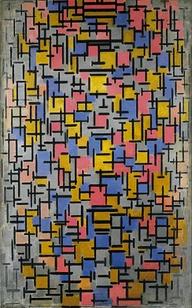
And then of course, there're the Dutch and the famous Piet Mondrian with his grids of vertical and horizontal lines. Somehow, I didn't realize he was Dutch and that others right beside him were part of the De Stijl movement. Nevertheless, his piece below simply blew me away. Everything is perfectly balanced and your eye moves around to methodically placed limited colors. Unlike Kandinsky, he employs layers upon layers of paint in a soft, calming way, once again - balanced.
 Piet Mondrian
 
It's a grand show, and a must for anyone in love with abstraction. It's also perfectly presented for those simply curious about the development of art in the 20th century and not quite getting what abstract art is all about. All the greats are here, perhaps with the purposeful ommission of the usual suspects like Picasso, Matisse and Cezanne. Kudos to MOMA and to its curatorial staff!


Friday, December 14, 2012

Uwe Kowski - my favorite artist at Art Basel Miami Beach

 
Represented by Eigen Art of Berlin, Uwe Kowski's work was a true discovery for me at this year's edition of Art Basel. Great sense of color, depth, and and very interesting strokes.

Wednesday, December 12, 2012

Balance

If you pay attention to spreading one color in a balanced way around the canvas, you don't run the risk of getting stuck in the details - a true pitfall. You're also then a lot more cognizant of the type of stroke you're making - for me it's the short horizontal slab with a palette knife that brings the most satisfaction, especially when there's sufficient color that your edge can examine their relationships. Another element that adds to the sameness of texture is s the tool you use, that is staying with same palette knife or brush if repetition is desired, or switching it to a thin outline with a tiny yet bold brush line. I'm certainly a descendant of Russian painters (Kandinsky, Chagall, Rothko), string  the bold black outline is very important to me after all, especially when it's a jagged dancing stroke that seems to resemble a sting. The appearance of this pulsating string seems to be more importance than simply the color relationships. Pay close attention to the palette you're mixing on for pleasing color combinations - this might be the best guide for your painting's progress if nothing else. And know when you get tired in order to stop before it's too late.

Wednesday, November 21, 2012

Volume

I set out to reach a point between figuration and abstraction where just enough is being said, but not quite so much to ellicit concrete references. I substituted a brush for a more expressive palette knife. I added texture with the impasto technique. I stopped taking photographs of the landscapes I paint in order to limit my desire to perfect a scene. And yet, with the passing of time it appears that my pieces are only getting more dense and representational. It bothers me that then I want to achieve perfect perspective, or ouline something just enough to be able to feel its mass. These wishes are too literal. They shouldn't be relevant in an abstract work. How easy it must be to just choose a few lines and take off without prior knowledge of proper means of representation. It is just so difficult to convince yourself to stay general, to break the piece simply into planes, or fields of color. It takes tremendous leaps of faith to trust yourself in a completion of a color relationship, in the placement of a bold line. Perhaps this is where the mastery is - to depart from a mere representation to a complicated and impactful world within. Perhaps this search for a place to call home would end where no known references reside. Till then, the search continues...