Showing posts with label lyrical abstraction. Show all posts

Thursday, November 16, 2017

Murakami vs Rothko at the MFA in Boston - is art meant to make you smile or cry?

There're a few new shows at the MFA currently that are quite interesting to me in their contrast to each other. It's the very much talked about Takashi Murakami exhibit vs. the Mark Rothko exhibit, which virtually noone knows about.
I find Murakami to be so flat, impersonal and superficial. Yes, he found a symbol that is now our association with him, that of the flowers with a somewhat sickening grin. When you see it, or especially them in bunches you immediately recognize that they're his. But what does it do to you as a viewer except for this pleasure of recognition? It invokes nothing. It's just a pure Pop statement that just like Warhol before him, or Lichtenstein or Jess Koons - has no emotional connection to anything in anyone's psyche.
And then I step into the world of Mark Rothko and I begin to weep while on my second painting. I can't really explain what makes me weep. It could be the layers of his emotionally charged juxtapositions of color. It could be the simplicity or the perceived simplicity of his vast rectangles chosen for all his compositions. But I can feel his fingertips spreading the paint, touching it, making it visceral, psychological, incredibly emotional. I can feel him getting to the core of the message, to the core of my soul. I see this incredibly powerful effect of layers on my psyche as a viewer.
If one encloses simple relationships that are of utmost importance in a casing that does not distract from the message, that's when it starts to say what it's meant to say. Therefore, in a way these two exhibits are about the same elements. There's a symbol or idea that is key, and through its repetition, within the same casings you see it manifesting as a style.
This casing or composition should not distract from the main idea and that's where I think my problem lies. My landscapes are always seen as of utmost importance, and the play of colors as secondary. When in reality what I want is for the landscape to translate as a shadow of itself, and for the real quest of color harmonies to manifest as a primary goal.
But my main issue with the perception of these two exhibits still remains. Are we as people of today more attracted to the superficiality of Murakami than the depth of feeling of Rothko? Or do auction prices for the sales of Rothko pieces say otherwise? Or were there always two camps of viewers - those who want to look at art and smile, and those who are searching for something that would make them cry?

Tuesday, March 15, 2016

Let your inner child play as long as she wants

Reflecting on a memory of a real landscape brings so many questions. Even after I figured out the mood for the painting, and limited my palette accordingly, I was still struggling with just how precise this depiction needs to be. As much as I wanted to leave the reality of the scene, things like perspective, shapes and textures of specific subjects were forcing me to stop and reconsider my every move.

When does this adherence to reality take a break, and lets the imagination take over? How can I open a door to creativity if a constant logical critic sits on my shoulder and demands accuracy and academic realism? How did Kandinsky accomplish this feat? To have a landscape and to not have it at the same time? To let shapes, colors and lines take over the composition? To have a real scene turn mythical, become a dreamscape?

I guess a lot of it is a dance of inner voices, but in a dance there's always a leading partner. How can the lead shift to a more abstract thinking section of the brain? Perhaps these voices relinquish control and don't take turns? When there's a real marriage of color and line - the trick is to not turn on the switch back to observation, and to just let yourself sink into the simple pleasures of mixing colors, the way a little child would, for hours.Yes, that is it. Just like I force myself (not always successfully) to not interfere and let my children play their game of choice for as long as they need, I need to not rush my inner child, and let her play as long as she wants. Then just stop before judgment kicks back in.

Then the goal is to repeat this for every painting session...and for every child's invented game.

Friday, May 15, 2015

Layers

I was part of a unique and very insightful workshop a few weeks ago, led by my art teacher and life coach Andrey Tamarchenko, and Judith Schafman, a psychologist who specialized in dream work.

It introduced me to a very counter-intuitive, yet very liberating approach to painting, which utilizes layers of meditation. The work therefore also consists of layers, often invisible. It bothered me at first that they're unseen - there I am putting all this energy in, and you can't see half of my work. But now that I've tried it a few times, I can tell that underlying sketches still remain - in the feel of the piece, in its energy. And when you keep reworking the painting, and are so afraid of taking sections away - they never do go away completely. Key elements will always be felt. It's such a stress relief to know that.

It's like when you start a new job and you feel that you're starting from scratch. Yet you always bring what you had already learned with you. When HR departments hire recent college graduates - I hope they know that those periods of intense research, sleepless nights, deadlines - were all there, they shaped a person's ability to concentrate. When one relationship ends and another starts - you're a person layered with knowledge of past mistakes and accomplishments...

I've begun to truly enjoy watercolors, after almost 20 years of utilizing them for sketches. I finally understand their layers and how nothing quite goes away, but can only be made better with time.

Wednesday, November 20, 2013

A Life of Contrast

It's been a few months that this post has been brooding in my head. I've finally realized that the quest for contrast is what I constantly look for in life - things lacking hard edges simply don't interest me.

I recently came back from an Antique art fair, where tons of soft 18th-19th century paintings graced red felt walls of many booths. I was so incredibly bored with them. They didn't have the punch of hard lines or complimentary colors juxtaposed next to each other, no delineated lights and darks. I couldn't sink into these paintings, couldn't dissolve.

William Guy Wall, Silver Cascade

I also incidentally spent a few days with an atmospheric abstract painter, and what I thought was always lacking in her work - a grounding of sorts - she noticed was overly prevalent in mine. She hated my rendering of trees for instance - saying they create a grid which interrupts the flow of the painting....After that critique I attempted to do without my typical hard branches and all I see is mud and chaos.

I guess we each seek and value key features of our personalities in our works and the works of others. It's never the opposites attract phenomenon. OCD'd like myself find order amidst chaos. A Buddhist finds a calm meditative space.

But then...I used to love radical people - those with a strong personality and unwavering opinions. Maybe it's because I'm too mainstream and blah? But now I see that these people are simply not tuned in to the world around them, they don't see shades of grey, don't see any nuances in human relationships. And I get to thinking that perhaps that is what's supposed to happen to my art - more nuances and less expression? That is what growing into your own means?

Thursday, March 28, 2013

The said and the unsaid

I went to the Sackler museum at Harvard a few days ago, thanks to my dear friend, Anna. What got me the most once again were the Chinese screens - their delicateness yet
simplicity. Every time I'm in front of those I'm amazed at how much empty space there is and how it makes perfect sense - it lets your mind complete the scene, there is no need to spell out every detail on the lace neckpiece or every wave in the endless sea. Don't get me wrong - the exquisite lines are also there to depict tree branches full of emotion and the vibrant garments of little soldiers, ane yet the silence is golden.

In Western tradition we're so preoccupied with perspective, form and shadows, that we give no credit to the onlooker at all, we leave no room for their imagination. It'd be so lovely to just be able to let it be - there's so much mystery and beauty in the void.

Anna mentioned in her post similar tendencies for importance of silence in Asian movie making, literature and music. I also wonder about plain conversation - do we say too much? Can the other person guess our correct emotions, moods and thoughts, even if they're masked by shallow conversation?


Friday, March 15, 2013

The ying and yang - finding harmony

I read today that caligraphers in China attempted for centuries to get away from interpretations of their lines as trees, clouds, pretty much any type of representational form that can be detected in their forms. When they finally accomplished this - they called it harmony in caligraphy itself. It's that strive for reality that constantly challenges a painting. If only I could see past it into the work itself, if I could shut down reality on the outside and access inner realities - that would be harmony.

The well known trick of turning the canvas sideways and upside down helps see more clearly. Then you can inspect every square inch in the piece and make sure it works. Or you squint your eyes and somehow see the whole message, not its multitutes of questions and realities. And if you stare into one random spot like the yogis and you search for that place inside that has harmony, that you can call home.

Enjoy the latest...

Wednesday, December 26, 2012

MOMA's Inventing Abstraction exhibit

Ending up in NYC by chance during the Holidays, I had a chance to view the groundbreaking Inventing Abstraction exhibit at MOMA in its first opening days. I have to say it was exactly what the doctor prescribed, a show the focus of which is the linking of a global strive towards abstraction. A huge map of connections, almost Linked-in like, greets you at the entrance, and you immediately realize that noone ever works in a vacuum, that all these separate geniuses whose work you admire for its originality, were in fact influenced by someone else perhaps even continents away. That famous phrase 'everything's been done before' no longer seems scary as it becomes clear that you can still find your voice in relationship to other voices.

Wassily Kandinsky

I also discovered during this show that abstract art has a formula, an easy one at first sight, but something that might take a while to adapt to in terms of your own preferences. The equation is made of three variables: color, paint application, and form. With my idol Kandinsky, forms obviously derive from a landscape, peaks and voids of mountains and gardens are visible, and a bold pure black line outlines them all. The canvas texture peaks thru as the color is applied in one expressive layer. To him, all the symbolism is in color: "I know what undreamed of possibilities color conceals within itself".

Robert and Sonia Delaunay research the sphere and place opposite colors side by side, shading their tonalities within a sphere.
Robert Delaunay
The futurists are all about hard lines, lots of cones, triangles and sharp edges. There's tremendous play of opposites and shading from light to dark. I especially loved Gino Severini, and the expressive strokes in his drawings.
Gino Severini
 
The Russian suprematists are difficult to grasp as it's just pure geometry and planes of color, but for them the very fine application of paint with tiny brushes across various planes seems key. Liubov Popova was a revisited discovery for me this time around.
Liobov Popova


Georgia O'Keefe all the way on the other side of the globe is so organic that it feels like she's painting plants or human forms and she's of course been criticized or applauded for that time and again, depending on the era. What she said I found truly powerful: "I found I could say things with color and shape that I couldn't say in any other way, things I had no words for." Her line is very musical, sensual and the palette is soft, pastel-like. A tiny brush and methodical application is, however, her method of paint application.
Georgia O'Keefe
 
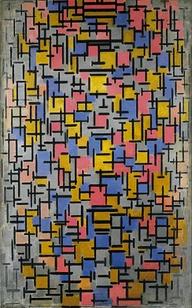
And then of course, there're the Dutch and the famous Piet Mondrian with his grids of vertical and horizontal lines. Somehow, I didn't realize he was Dutch and that others right beside him were part of the De Stijl movement. Nevertheless, his piece below simply blew me away. Everything is perfectly balanced and your eye moves around to methodically placed limited colors. Unlike Kandinsky, he employs layers upon layers of paint in a soft, calming way, once again - balanced.
 Piet Mondrian
 
It's a grand show, and a must for anyone in love with abstraction. It's also perfectly presented for those simply curious about the development of art in the 20th century and not quite getting what abstract art is all about. All the greats are here, perhaps with the purposeful ommission of the usual suspects like Picasso, Matisse and Cezanne. Kudos to MOMA and to its curatorial staff!


Friday, December 14, 2012

Uwe Kowski - my favorite artist at Art Basel Miami Beach

 
Represented by Eigen Art of Berlin, Uwe Kowski's work was a true discovery for me at this year's edition of Art Basel. Great sense of color, depth, and and very interesting strokes.