Showing posts with label texture. Show all posts

Thursday, January 5, 2017

How to balance out home and work priorities

When I was little, my favorite summer pastime was building sandcastles on a beach. I'd sit by the edge of the water for hours, picking up melting sand and creating these Gaudi-like structures. They'd get washed away by the waves all the time, but it didn't matter. It was this constant transformation of sand affected by water into semi-stable castles that drew me.

This year didn't start off well in my head. I was preoccupied with all the wrong things - popularity, fame, success, jealousy. I was so down on myself that I would retreat and ignore my family, my everyday joys, my accomplishments.

It's only today that I, once again feeling this childish joy of building castles with melted wax and paint, had realized that my word for this year should be process. It's the process I enjoy while painting, teaching, parenting. It's never been about monetary gain.

It's me loving how a first layer of paint is being partially covered up in a semi-transparent coating. Or, it's the grooves of existing layers peeking through the scratched off surfaces. It's the great multitude of these fragile sand castles that I build in each painting that excite me. It's the joy of my kids saying and doing something wonderfully new and unique every single day, my husband supporting me every step of the way. My word for 2017 is process.

Tuesday, December 13, 2016

Do you see recurring symbols?

There're forms that want to come back time and again, symbols that allow me to uncover certain truths, highlight what hides beneath.

An arched stone bridge - what is the significance of its recurring draw for me? Is it the playful texture of the stones, with enigmatic treasures reflecting in the water below? Is it the contrast of manmade patterns, so carefully assembled, against the smooth reflections of the trees, their branches haphazardly yet gorgeously striking the void?

If I am indeed always painting how I feel about myself, then is it that struggle of contrasts that draws me in? To be agreeable, yet enigmatic, and ambitious but understood, daring, provocative but feminine, delicate, beautiful, balanced, in harmony? Yes, quite a few contradictions to stuff into one painting, with the hope that they will all be apparent to the viewer, that they will all be accepted. What if just some of them are apparent? Or what if the onlooker only sees what he/she wants to see, irrelevant of my struggles and intent?

These symbols which might mean one thing to me, and something entirely different to someone else, they're still elements of a pictorial language through which we communicate. And communication is never easy, even if we all speak the same tongue. We always miss nuances, refuse to see what's just below the surface. Do you see a woman hiding in this painting?

Monday, December 12, 2016

Do you ever wish for a Do-over?

This is the first time I painted over one of my old canvases. Typically, it's very tough for me to let go of even my most disliked pieces, but I wanted this challenge of working on top of something already formed. I thought it would be so wonderful to already have a textured work from the get go, so that I wouldn't have to spend the time establishing texture from the ground up. How fundamentally wrong was I!

All the lines and grooves are formed in all the wrong places for this current piece, and every new layer is going against the grain of what's already established. It's like you're trying to change someone whose personality has been formed long ago.

At some point, however, you realize that old scars won't go away. All you can do is simply work with them, bring a new light to them, a brighter life. Yes, it is typically escapism that I'm after in my work, but it doesn't have to erase all notions of my reality. It can bring me to a new place by building on top of what's there.

 It comes out as an antiqued Instagram photo, with patches of seemingly forgotten white space open for interpretation. Some layers are scratched off to the very core of my original marks, with a new mask seemingly hiding all wounds. However, the more you add to an existing patch of texture, the more sophisticated it becomes...

Wednesday, September 21, 2016

How to enter the 4th dimension!

What has this painting experience been about? It seemed like there was so much happening - different brushstrokes, painting with negative space, frustrations with the carrying out of the idea. Yet I think what kept creeping back is this search for a time warp.

I keep noticing that when I paint, I enter a timeless zone. The clock seems to stop. I accomplish so many transformations. A whole myriad of thoughts, directions, critiques are streaming through my mind. I look back and notice that only a half hour passed, or an hour, or I've been at it for three hours. I've managed to enter a fourth dimension - I'm in the past, and in the present, and in the future at the same time.

My painting practice beckons me to let go of everyday worries and step into a different space, a transformative experience where nothing else matters but my color mixing, final application and the movement of the composition. It is so tempting to get away from it all, to remain in solitude, in conversation only with my own thoughts. It's more addicting than any drug - this desire to understand the depths of me.

Thursday, May 5, 2016

If Henri Rousseau persevered - we all can!

It was going so well up until judgment day. There were experiments and free play. There was a sense of joy in discovery, a feeling a pioneer or a scientist might have mixing unconventional techniques and ideas. And after a number of compliments I decided I'll put this piece into a juried museum call. In order to do that, I needed to finish it that day and all of a sudden I froze.

All these preemptive feelings of shame of rejection, the nervous anxiety of anticipation overtook my creative flow. I couldn't put down a single stroke without worrying that it'll ruin the piece.

How is it that some people are such natural salesmen? How is it that their stomachs don't churn at the thought of criticism and disapproval? Why does the life of an artist have to be so full of punishments?

Yes, I can tell myself time and again that this isn't about someone's appreciation of my work. But that's a lie. I want to be seen, I want the attention these pieces deserve. I want them bought, auctioned off, hanging in museums. I want to be earning money as an artist. Why even after so many years in the industry do I not get the formula? Is my art too shallow, too impersonal? Do people need to bleed from the inside in order for me to succeed? You take what's most precious to you, turn yourself inside out and only then do you get noticed? Or does it have to be completely void of any personal touch and be an abstract blob?

I'm just thrilled I had read a children's book to my students recently on the life of Henri Rousseau, on his yearly rejections and his ability to persevere. If only I could have the same strength and not take this whole process so close to heart...

Wednesday, February 10, 2016

How important are your acquaintenance relationships?

As I embarked on the color theory journey along with my students, I feel that I'm getting lessons in subtlety. When you limit yourself to the very basic means, you only then start seeing nuances in relationships, in shades - those fifty shades of any color, in vibrancy, in temperature, and in transparency.

Everything doesn't need to be harsh, full of contrast, jarring in order to make an impact. Most of the time, the beauty lies in the subtle mixes of colors, and even more so in their transparent layers. An opaque layer covers all your tracks, all your moods of yesterday. While semi-opaque or translucent layers are able to neutralize if too much has been said, or add a little accent of focus.

All my life I've been searching for only the deepest relationships. It's all or nothing. You're not making it onto my friend list if we can't have the most intimate conversations. Mere acquaintances would stay by the wayside, as that's just what they were. I dismissed so many wonderful people because of this all or nothing approach. In reality, however, one can gain so much from even the smallest encounter with a stranger, or a mentor/student relationship, developing both ways. So much can be learnt from an inconsequential family visit, or a cocktail party conversation. Everything happens for a reason, and if you're only after the most idealistic statements, you miss the nuances, the everyday messages of life. I love this new bare essentials approach.

Wednesday, November 4, 2015

How do you set your priorities?

This painting has been haunting me in its purpose because it's a sudden internal shift from trees and all their symbolism to a cityscape. Did I need to do that for more people to understand me, or was it something inside of me that wanted a new or rather re-visited challenge? The answer to this question I don't know even now after the painting is finished.

What I do know is that it was a true lesson in setting priorities. What is more important to me - the infinite sky, the haunting water, or this magical town highlighted by rays of sunshine? It was a constant adjustment of what hides and what comes out. Especially fascinating was how the darkening of one element brought out another. 

One day my friend and teacher, Andrey Tamarchenko, came to visit, and said that textures can be varied throughout - treatment of water and sky should be softer than the rough outlines of a city with its decaying walls. I ended up making the sky and water more pale, and suddenly the city became clearer, as if coming out of a mist. But it bothered me because the city wasn't my focal point. It was actually the opposite - what I loved was the cityscape's complete integration into the landscape, how it effortlessly coexisted with the cloudy sky and the murky water. I changed it yet again to level out the planes, and that made me happy. So is the lesson to take away from this process the opposite of what I'd initially thought, and in fact you can really have it all? Or that perhaps you always need to make a list of priorities?

Tuesday, June 9, 2015

Traps

This painting has been a torture. It was attempting to come to life amidst declines from juried shows and galleries. I was in a particularly foul mood for weeks. Yet, it has been moving along despite it all and in a very strange way. I've been noticing that the drips don't just come down, (laws of physics and all), - they follow certain ridges and roads that I had left previously. Every time I would come back to paint, I'd be afraid that things would progress too fast. Yet, my barriers created intriguing little turns and twists for paint to follow.

At first, those closed gates seemed to play along with my depressive tune - 'you can't jump over your head', 'you can't go beyond your pre-set limitations' - little mean voice inside my head kept saying...

And then I returned one last time and suddenly thought - 'But wait, I am the one who creates these closed gates. It's completely up to me to open some and close others. It's my choice to direct the flow slightly. I set my own traps.

Just like in life, I can always walk into those pre-designed lived-in scenarios. Or, I can make a conscious decision to behave differently - not sacrifice myself, my time, my energy, but create more meaningful satisfying relationships.

It was truly brought home when I would stand as usual with one arm melting the paint, and the other holding a palette knife, ready to place another automatic mark in another section of the painting. But something inside of me kept saying time and again - 'no, put down the knife, use this arm to consciously turn the canvas and create new paths'...and I did.

Friday, May 15, 2015

Layers

I was part of a unique and very insightful workshop a few weeks ago, led by my art teacher and life coach Andrey Tamarchenko, and Judith Schafman, a psychologist who specialized in dream work.

It introduced me to a very counter-intuitive, yet very liberating approach to painting, which utilizes layers of meditation. The work therefore also consists of layers, often invisible. It bothered me at first that they're unseen - there I am putting all this energy in, and you can't see half of my work. But now that I've tried it a few times, I can tell that underlying sketches still remain - in the feel of the piece, in its energy. And when you keep reworking the painting, and are so afraid of taking sections away - they never do go away completely. Key elements will always be felt. It's such a stress relief to know that.

It's like when you start a new job and you feel that you're starting from scratch. Yet you always bring what you had already learned with you. When HR departments hire recent college graduates - I hope they know that those periods of intense research, sleepless nights, deadlines - were all there, they shaped a person's ability to concentrate. When one relationship ends and another starts - you're a person layered with knowledge of past mistakes and accomplishments...

I've begun to truly enjoy watercolors, after almost 20 years of utilizing them for sketches. I finally understand their layers and how nothing quite goes away, but can only be made better with time.

Friday, June 7, 2013

Simple matter of palette observation


My work is always about color but it seems I always arrive at it accidentally. Somehow one hue ends up next to another and forms a perfect relationship. I'm not able to mindfully replicate it. It just sort of happens every time. However, all these trials end up on a palette and it can be part of practice to simply remember what works well with what, based on my own preferences of course, as it's all subjective.
We discussed with my mentor how this attempt to arrive at a formula that ws orks for the art world doesn't quite work. One's palette is truly a phenomenon of the left side of the brain, and simply pours out subconsciously. I still think it's doable, however, without it turning into automation.
Just say to yourself, pale green and subtle pink is a pair, and so is violet and lemon yellow, cadmium red looks stunning next to sage green...Or am I just now naming opposites on a color wheel, impressionist style?
Well, I tried to take these relationships to heart with this latest piece, and I think it sort of works, no?
I was also thinking that I always hated the color green, as it's so blah, and difficult to capture in all its various hues. But when I look at my work, it seems the parts I enjoy the most are the subtle relationships of various greens. So the idea for the summer is to limit myself and simply create a green painting...

Sunday, February 10, 2013

Doesn't everyone love ice cream?

That's the consistency of oil paint when it's mixed with wax and it almost feels like you can taste the different flavors: sweet red or tart green or chocolate brown. It just feels so malleable and soft when the hard edge of a palette knife brings it all together.

Now the palette knife - its main quality is scraping, having new color intrude on the old but not kill it, rather let it peak out in just the right proportions. That's why everyone is so into Gerhard Richter's work with scratched out surfaces. It marries the old and the new in unexpected combinations  - the flavors of ice cream never before attempted together.

You see the function of color best in Monet, Rothko, Pollock, Kandinsky. De Kooning I think was a total anti-colorist just as Picasso before him. Vuillard and Bonnard, Matisse - the fauves are seeing color in a completely separate light.

Friday, February 1, 2013

Switching hats: art sales vs. art creation

Love the story line disappearing into abstract background

Sam Francis - blobs of paint in opposite colors
So I was wearing an old hat last week, that of an art consultant attempting to sell some art to the somewhat interested public. It's amazing how quickly a different mindset kicks in. Within an hour I programmed myself to disregard artists trying to peddle their wares, to snob students and event organizers, and to hate dealers pushing the same things for less and being successful at it. What a thankless and personality-altering job it is to be in sales. A true salesperson forgets to be civil unless he gets paid for it, would only pretend to be a team player to somehow benefit from it and will wish you good luck or congratulate you on your sales hoping you fall to the lowest depths right after this one successful transaction.


And though I thought that having been in this world would help me in entering it as an artist, it seems that my mind cannot function simultaneously in various roles. I can look at art as a dealer, judging what might sell well and for how much. I can look at art as an art critic for its successful formal aspects. However, I cannot apply the same principles to my own art. I cannot tell myself to do this or that in accordance with current trends in the market. My voice just sort of comes from within and that's the end of the story. However, here're some of my personal favorites from the show and why I liked them.


Wednesday, December 26, 2012

MOMA's Inventing Abstraction exhibit

Ending up in NYC by chance during the Holidays, I had a chance to view the groundbreaking Inventing Abstraction exhibit at MOMA in its first opening days. I have to say it was exactly what the doctor prescribed, a show the focus of which is the linking of a global strive towards abstraction. A huge map of connections, almost Linked-in like, greets you at the entrance, and you immediately realize that noone ever works in a vacuum, that all these separate geniuses whose work you admire for its originality, were in fact influenced by someone else perhaps even continents away. That famous phrase 'everything's been done before' no longer seems scary as it becomes clear that you can still find your voice in relationship to other voices.

Wassily Kandinsky

I also discovered during this show that abstract art has a formula, an easy one at first sight, but something that might take a while to adapt to in terms of your own preferences. The equation is made of three variables: color, paint application, and form. With my idol Kandinsky, forms obviously derive from a landscape, peaks and voids of mountains and gardens are visible, and a bold pure black line outlines them all. The canvas texture peaks thru as the color is applied in one expressive layer. To him, all the symbolism is in color: "I know what undreamed of possibilities color conceals within itself".

Robert and Sonia Delaunay research the sphere and place opposite colors side by side, shading their tonalities within a sphere.
Robert Delaunay
The futurists are all about hard lines, lots of cones, triangles and sharp edges. There's tremendous play of opposites and shading from light to dark. I especially loved Gino Severini, and the expressive strokes in his drawings.
Gino Severini
 
The Russian suprematists are difficult to grasp as it's just pure geometry and planes of color, but for them the very fine application of paint with tiny brushes across various planes seems key. Liubov Popova was a revisited discovery for me this time around.
Liobov Popova


Georgia O'Keefe all the way on the other side of the globe is so organic that it feels like she's painting plants or human forms and she's of course been criticized or applauded for that time and again, depending on the era. What she said I found truly powerful: "I found I could say things with color and shape that I couldn't say in any other way, things I had no words for." Her line is very musical, sensual and the palette is soft, pastel-like. A tiny brush and methodical application is, however, her method of paint application.
Georgia O'Keefe
 
And then of course, there're the Dutch and the famous Piet Mondrian with his grids of vertical and horizontal lines. Somehow, I didn't realize he was Dutch and that others right beside him were part of the De Stijl movement. Nevertheless, his piece below simply blew me away. Everything is perfectly balanced and your eye moves around to methodically placed limited colors. Unlike Kandinsky, he employs layers upon layers of paint in a soft, calming way, once again - balanced.
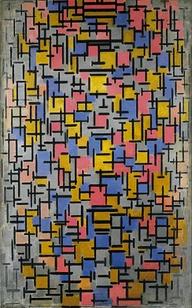
 Piet Mondrian
 
It's a grand show, and a must for anyone in love with abstraction. It's also perfectly presented for those simply curious about the development of art in the 20th century and not quite getting what abstract art is all about. All the greats are here, perhaps with the purposeful ommission of the usual suspects like Picasso, Matisse and Cezanne. Kudos to MOMA and to its curatorial staff!


Friday, December 14, 2012

Uwe Kowski - my favorite artist at Art Basel Miami Beach

 
Represented by Eigen Art of Berlin, Uwe Kowski's work was a true discovery for me at this year's edition of Art Basel. Great sense of color, depth, and and very interesting strokes.

Wednesday, December 12, 2012

Balance

If you pay attention to spreading one color in a balanced way around the canvas, you don't run the risk of getting stuck in the details - a true pitfall. You're also then a lot more cognizant of the type of stroke you're making - for me it's the short horizontal slab with a palette knife that brings the most satisfaction, especially when there's sufficient color that your edge can examine their relationships. Another element that adds to the sameness of texture is s the tool you use, that is staying with same palette knife or brush if repetition is desired, or switching it to a thin outline with a tiny yet bold brush line. I'm certainly a descendant of Russian painters (Kandinsky, Chagall, Rothko), string  the bold black outline is very important to me after all, especially when it's a jagged dancing stroke that seems to resemble a sting. The appearance of this pulsating string seems to be more importance than simply the color relationships. Pay close attention to the palette you're mixing on for pleasing color combinations - this might be the best guide for your painting's progress if nothing else. And know when you get tired in order to stop before it's too late.

Wednesday, November 21, 2012

Volume

I set out to reach a point between figuration and abstraction where just enough is being said, but not quite so much to ellicit concrete references. I substituted a brush for a more expressive palette knife. I added texture with the impasto technique. I stopped taking photographs of the landscapes I paint in order to limit my desire to perfect a scene. And yet, with the passing of time it appears that my pieces are only getting more dense and representational. It bothers me that then I want to achieve perfect perspective, or ouline something just enough to be able to feel its mass. These wishes are too literal. They shouldn't be relevant in an abstract work. How easy it must be to just choose a few lines and take off without prior knowledge of proper means of representation. It is just so difficult to convince yourself to stay general, to break the piece simply into planes, or fields of color. It takes tremendous leaps of faith to trust yourself in a completion of a color relationship, in the placement of a bold line. Perhaps this is where the mastery is - to depart from a mere representation to a complicated and impactful world within. Perhaps this search for a place to call home would end where no known references reside. Till then, the search continues...

Friday, November 9, 2012

Have you checked what you're listening to lately?

So it may seem obvious or it may not, but what's on my stereo is always influencing what gets out and on to canvas. I've grown up with hard rock music and oftentimes it triggers nostalgic memories and aids me in bringing me back to my roots and their expression. Other times, it's just too strong of an influence. The lyrics are meddling with my thought process, making me unable to focus and concentrate. A Latin motive may elicit more energy than I may have had on a given day, but it soon begins to almost dictate what type of line and color it wants. Classical or soft jazz rhythms are usually too calming for me. My art sensibilities require peaks and voids and strong voices or instruments. However, I am always in search of meditational music that focuses on repetitions of phrases that I cannot understand. Then, it's simply a voice that I react to and it's almost like a conversation in the background an the foreground. It's a prety incredible exercise to switch between various musical genres during an art studio visit. But, beware of what it may do to a painting. It may make it a bit too saturated and confusing.

Thursday, October 18, 2012

Moods

A body of work is starting to come together and though I sense similarities in a palette and obviously the theme of landscape, each one of these pieces is incredibly different in terms of its mood. It's truly remarkable how my current state of being is influencing the piece. These past few months have been stressful and panicky with a new baby. As a result, my latest painting, 'Lilac Day', is simply making me nervous. The lines are anxiously spreading in all kinds of directions, the contrasts in colors are highly overt. There's true tension here, especially in comparison to the previous piece, 'Mount Fuji'. Now could it be as simple as direction of a line and a balanced out composition? Or is this a result of a transfer to a much more expressive palette knife paint application and addition of wax medium to create texture? The only way to find out is to mix the two: use up the little remaining wax with a palette knife and then move back to painting with a brush. Would this result in a piece with an interesting mix of moods or would it simply become muddy and confusing? We shall see.

Wednesday, September 26, 2012

Brushstrokes

Looking at my 4 year old the other day carefully placing identical blobs of color onto a piece of paper, (due to his under developed fine motor skills of course), I began to wonder whether this is the right way to go in order to achieve balance in a painting. That is should I carefully continue with a chosen direction and method of applying a stroke, a la Van Gogh or the Pointillists, as opposed to acting on impulse and taking cues from hand movements? If you simply follow your instincts, then the piece shows intensity but also chaos and instability. If all brushstrokes flow simultaneously, then there's serenity and the eye is calmer when it moves around the work. Question is what do you want to achieve, and is this result what you'd be happy with for the moment, or is it good enough to live with for a lifetime?

Tuesday, September 18, 2012

Texture

So I've decided to revisit texture via a combination of oil and wax. It is incredible how different the painting process feels with this quick change of course. The paint all of a sudden has mass and feels like a true substance with lots of volume. The colors blend in but keep their original intensity and peek through without layering. Most importantly, the expressive nature of the painting becomes that much more immediate. A palette knife allows the inner urge to spill out emotions to come through so much more readily than a paint brush. It feels as if once you know that paint cannot be smoothed out, you relax and simly let it breathe. The canvas underneath has its say as well as it doesn't need to be covered up but rather acts as another element in a carved out piece. It's truly a marriage made in heaven me painting this way. I feel that it will very soon lead to the long awaited abstract effect that I've been seeking.